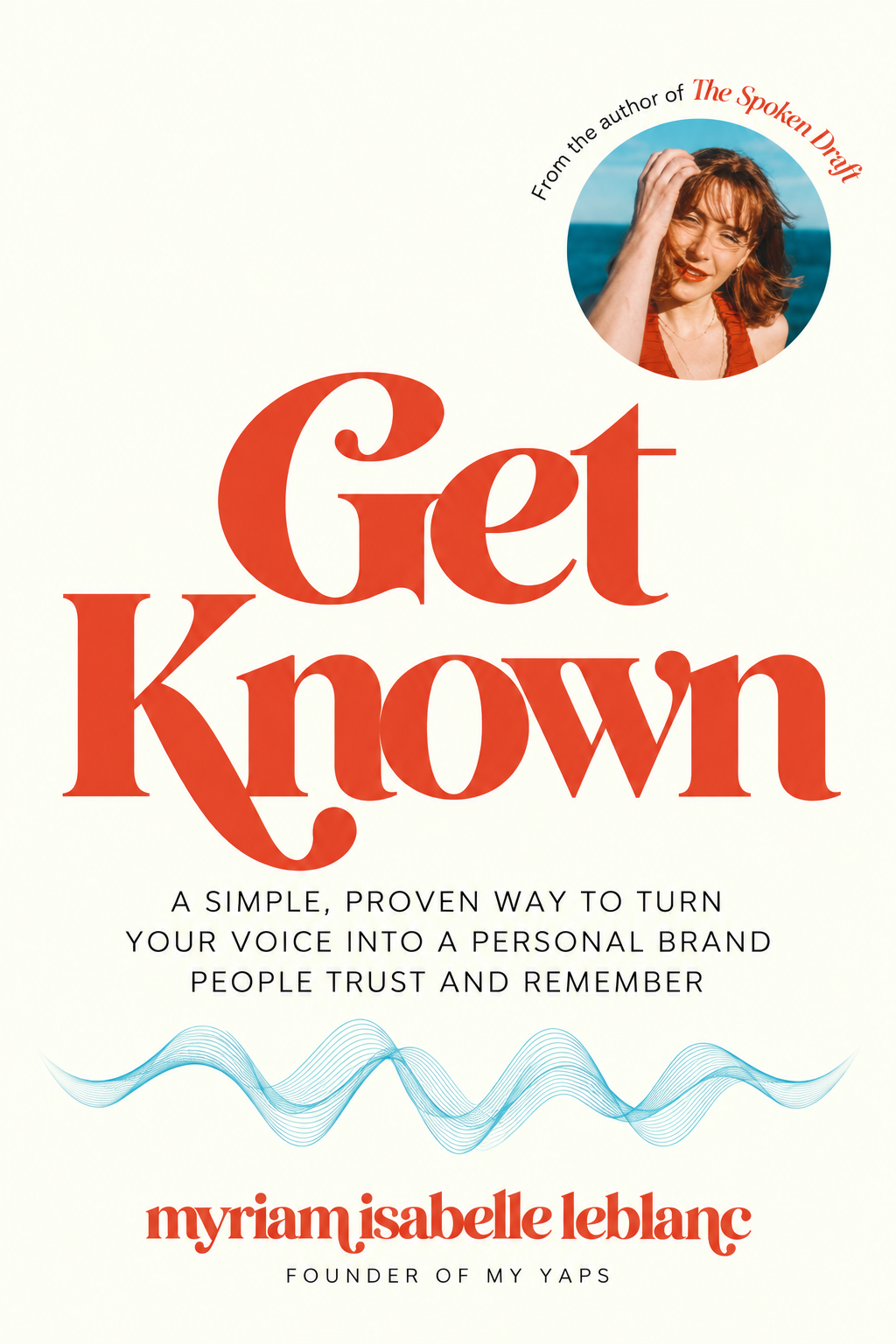
The Spoken Draft
— A new book by Myriam Isabelle Leblanc —

The idea you've carried
for years isn't stuck.
It's unfiled.

For the woman with a hundred tabs open, twelve Notes app pages, and nothing in the world yet — you say it out loud first, and organise it after.

Yes! Rush me a copy — $20
Ebook only · Instant download

The Thing You've Been Carrying

There's a project in you that has been in there long enough to stop feeling like a project.

It's in the tabs you opened in February and can't close, because what if that was the one. It's in the Notes app entry wedged between a grocery list and a screenshot of an apartment you'll never rent. It's in the four documents with a strong opening paragraph and then nothing. It's in the Notion workspace you rebuilt three times, and the third one is beautiful, and it's empty.

And somewhere around 11 p.m., the sentences start. "I know exactly what I want to create. I can literally see it in my head. I just don't know how to get it out." "I never finish anything." "Maybe I'm not actually capable of this."

If any of that sounds familiar, you're not alone, and you're not broken. Something in you has been reading the pile as a verdict on your character. It isn't one.

You're not scattered. Scattered means thin. You're full. Your capacity is being spent, all day, on holding, because an idea that never properly left your head has to be kept alive by you. In the shower. On a run. Halfway through dinner with people you love. Three words on a loop: don't forget this, don't forget this.

That isn't creating. That's warehousing. And it costs exactly what warehousing costs: the space you needed for something else.

The Shocking Truth About Why You're Still Stuck

The story you've been told is that you lack discipline. Write every day. Sit down. Focus. Push through.

It seems reasonable, because it works beautifully for a certain kind of person, and those people write most of the books.

Here's the quiet problem with it. Every one of those methods assumes your bottleneck is producing words. That you already know what you mean and simply need to type it out in sequence.

Look at your actual life. You can describe this idea to your sister on the phone in eleven minutes, with the good parts in the right order, and she'll tell you it sounds amazing. You've told it at three dinners. You have a version that makes people lean in.

Words were never your shortage. You have too many of them, arriving at inconvenient times, from a brain that won't stop generating.

You were handed a bigger shovel when what you needed was a door.

Why Traditional Approaches Keep You Trapped

Most of us met the same system around age six. Sit down. Be quiet. Follow the steps. Organise everything before you begin. Hand in the final version.

That's a decent way to run an exam. It's a difficult way to make something that has never existed, because the right answer isn't available in advance and the finished version is the last thing to show up, not the first.

School never once asked to see the ugly middle. Twelve years of that and you learn, in your body, that a thing is only allowed to be seen once it's done. So the messy version has nowhere legitimate to live. It stays in your head, where it's safe and useless.

Then fear puts on a business-casual outfit. "I need to figure out my niche first." "I need a better plan." "I need to make sure this is the right idea." Perfectly reasonable sentences. None of them has a date or an end, which is how you spot them.

See, I Was Just Like You…

I'm Myriam Isabelle Leblanc, and for most of my life I thought my biggest creative flaw was that I talked too much.

I talked through everything. Ideas, problems, decisions, feelings, other people's feelings. Everyone else seemed able to sit quietly, organise the whole thing internally, and produce the finished version. I needed to say it before I could see it, and I filed that under personality flaw.

So I did the sensible thing. Business school with honours, then an MBA and a CPA, because at some point I decided the way to feel safe was to collect credentials. I bought the books and highlighted them beautifully, colour-coded, during a period when I genuinely believed a clean note-taking system counted as a personality. I could quote them at dinner. I could not tell you one thing I did differently the week after finishing any of them.

Meanwhile I opened a blank document and my brain emptied like a sink. I could explain exactly what I meant to a friend over an overpriced coffee, in full paragraphs, with hand gestures, and then sit down an hour later with the literary abilities of a potato.

Later I made a cat brand while working a full-time job, and it worked, and I still kept chasing the next shiny idea instead of staying with the thing that was already alive. That cost me years of momentum and eventually my energy entirely. Selling it forced me to look at how I'd actually been working, which is not something I'd wish on anyone at that particular moment in their life, and also the only reason this book exists.

Then I noticed something I'd been doing for years without a name for it. Every single thing I've made came out of my mouth before it existed anywhere else.

The Externalization Revolution

Clarity isn't found. It's spoken.

An unspoken idea is enormous the way a room is enormous when the lights are off. You know there's furniture in there. You know roughly where the couch is. You wouldn't want to walk across it barefoot.

And it stays that size because it's inside you, not because it's actually that big. Say it out loud and something specific happens in about four seconds. It gets edges. It gets a shape you can put your hands on. Usually it gets smaller, because most of what made it feel infinite was the fog around it.

You also get something you can't get any other way: a reaction. You hear yourself say a sentence and think, oh, that's good, I didn't know I thought that. Ten seconds later you hear something else and think, that's nonsense, I've been repeating that to myself for a year. Both are progress. Neither is available while the thought is still in your head, because in there, there's no distance between you and the idea.

The Spoken Draft

The method in this book is called the Spoken Draft, and the one-line version is this: get it out of your head first, organise it after.

Your voice is the draft. Not the note about the draft, not the outline you'll expand later when you finally have a clear morning. The talking is the first version, and everything after it is editing.

It works from the root cause rather than the symptom. Your problem was never producing words or wanting it badly enough. Your ideas were simply stored in the one place where nothing could be done to them. That's a mechanics problem, and mechanics problems have solutions.

It's also very old. Homer had no desk. The Odyssey lived as sound for generations before anyone wrote it down. The Quebec stories I grew up on travelled the same way, mouth to mouth around a table, worn smooth by a hundred tellings before anybody bothered with paper.

You can have the whole thing tonight.

Yes! Rush me a copy — $20
Instant download

The Five Stages of the Spoken Draft Loop

Get it out of your head first, organise it after.

01
Speak
You open a recorder and talk about the thing, with no plan, correcting yourself out loud. The sentence that starts with "actually, what I'm really trying to say is" is almost always the one you were looking for.
02
See
Your talking becomes text you can scroll and cut. Your relationship to your own thinking changes the instant it's in front of you on a screen.
03
Iterate
You react to it. Keep this, delete that, this doesn't sound like me, I forgot a story. An editorial conversation with yourself, held out loud, where you can finally hear both sides.
04
Ship
The version that exists goes where someone who isn't obligated to be nice to you can see it. Not because it's finished. Because reality holds information your brain has no access to.
05
Learn, then speak again
What people quoted back. What they misunderstood. What landed with nobody. Then you return to speaking with better material than you could have invented alone.

What Others Are Saying

"“I’m genuinely not a talker. I came to this because I wanted a voice, not a productivity system. What changed was that I stopped treating my first version as a verdict on me.”"

— Early reader, quiet creative

"“Four minutes on a walk. There was one line in the transcript I’ve been trying to write for three years.”"

— Early reader, founder

"“My commute is a launch plan now. Nothing else in my week changed.”"

— Early reader, working mother of two

Proven Results

A founder I met over lunch in Lisbon could see his entire business at once. The customer, why the existing options were bad, the systems, the hiring, the logistics, all of it equally urgent and all of it in his head.

He didn't need a course on operations. He needed forty minutes of talking out loud so the thing would stop being a world and start being a list.

What You'll Discover Inside

01
The Thinking-Feels-Like-Progress Trap
Why nine hours of thinking about your idea leaves you satisfied and empty-handed, and how to tell the difference from the inside.
02
You're not scattered, you're full
The distinction that takes the moral weight out of every unfinished document you own.
03
The filing problem
Why what looks like writer's block is usually a logistics failure wearing a talent verdict's clothes.
04
The four things that have to happen
The sequence behind every finished thing, and the exact failure you get when you skip each one.
05
What Homer's singers were actually doing
The classicists who went looking for memorised epics and found something far more useful to you.
06
The canoe that flew before anyone wrote it down
A Quebec story, a family with almost no formal schooling, and what survived anyway.
07
Your Library and your Glossary
How your own phrasing, references and refusals get captured so the work comes back sounding recognisably like you.
08
Fear in business casual
The five sentences that sound like project management, and the one question that exposes them in about four seconds.
09
Ship the version that exists
What it looked like to launch a cat brand with almost all the budget in inventory and almost none in polish, and why that order matters.
10
One thought, many assets
How a single forty minute walk with the dog became a chapter, several posts, an email and the outline of a launch.
11
The 48-Hour Reflex Test
Two days, one recorder, and one number at the end that most people find quietly shocking.

Is This Right For You?

This is probably not for you if —
  • You already take ideas from your head to execution to iteration on a reliable schedule. You're fine. Go make things.
  • You need the outline before you can think. Thought first, structure second is the order here, and it isn't going to reverse.
  • You'd like a forty-two part Notion system that takes a weekend to configure and then quietly rots.
  • You want permission to lower the bar. This is about getting something real into the world so you have something to raise the bar against.
This is for —
  • The creative founders, the overthinkers, the multi-passionate women, the ambitious weirdos.
  • The one who has been working on her idea for six months and still hasn't made the thing.
  • The one who was called scattered by people who meant it kindly.
  • If you have too many ideas rather than too few, you're in the right place.
Yes! Rush me a copy — $20
Instant download

Frequently Asked Questions

Is this just another productivity book?
No morning routine, no app stack, no system to configure. It's a working manual about one move: getting the thought out of your head before you try to make it good.
I'm not a talker. Does this still work?
One of the people it changed most is genuinely quiet. She came to it wanting a voice, not speed. What she discovered was a different relationship with her own thinking, which turns out to be the real gift here.
How fast might I notice something?
The first exercise takes one minute and happens on page five. Most readers find their idea living somewhere other than their body by the next morning, and they notice it at breakfast.
Do I need special tools or a microphone?
The recorder that came with your phone is enough. There's a whole passage in the book about people who spend a weekend choosing a transcription app for a voice memo they never record, written with love, because that was me about eleven other things.
Isn't this just letting AI write for me?
No. AI doesn't write my things. It puts my thoughts down. The structure comes from you, the examples come from your life, and the final edits are made by you, in bed, reading it like it's someone else's book.
What if I have too many ideas to choose between?
That's addressed directly. You'll discover how to capture an idea without acting on it, so you can follow one thing without losing the other forty-seven.
Myriam Isabelle Leblanc

Myriam Isabelle Leblanc.

Myriam Isabelle Leblanc is a woman who talks to her phone on the street, usually with a dog named Cleo walking beside her.

She's 31, with business school honours, an MBA and a CPA collected largely because credentials felt safe. She was a fashion buyer at Simons, learning how a product becomes a world people want to walk into. She worked in fundraising at the Canadian Red Cross, writing proposals for million-dollar gifts and meeting refugees during the Ukraine crisis and after the earthquake in Turkey, then coming home and turning what she'd seen into something that could move a donor in an office in Montreal.

She made Bloire, a community of 150,000 people around cats and design, which grew into a seven-figure company and eventually merged into Ecocat, where she's still a shareholder. Her personal world, My Yaps, went from nothing to 25,000 people in two months. Two books now exist because she talked them into existing. One of them, Gust of Wind, isn't out yet.

None of that looks like a career on paper. But look at how each one actually got made and it's the same move every time. She talked. She captured it. She shaped it. Then she made something out of it.

Her mission is simple: she'd genuinely rather help someone get an idea out of their head than sell them anything.

Say It First, Then Watch What Happens

Picture a Thursday where the idea arrives and by evening it's a file instead of a burden. Where someone asks what you're working on and instead of describing it beautifully for eleven minutes, you send them a link. Where the record you keep of yourself stops being a list of things you abandoned and starts being a short, uneven list of things that exist.

The question you carry around changes shape. You stop asking whether you can do this and start asking what you're going to make next, which is a much better question to walk around with.

It's just still inside you

Not too big.
Not too late.
Just still inside you.

Get Say It First here, and say it tonight.

Yes! Rush me a copy — $20
Love it or don't pay · Ebook only · Instant download